
Batch Production Accounting in a Leathercraft Workshop
A step-by-step walkthrough of a 10-piece leather clutch batch: material procurement, recipe card, inventory write-off, and net profit (P&L).
Introductory Note on Pricing
All material, hardware, and chemical prices in this guide are provided as practical reference benchmarks for a cohesive calculation model. Every craftsman works with distinct supplier rates, regional shipping costs, and hourly wage targets. The primary goal of this case study is to demonstrate the structural relationships, the recipe card breakdown, the inventory write-off sequence, and the exact mathematical reconciliation of the Profit and Loss statement (P&L) in OmniCraft ERP, into which you can easily plug your own actual supplier receipts and invoices.
Initial Parameters: Bespoke Leather Goods Workshop
For this practical walkthrough, we take the standard scenario of an independent leathercraft artisan or small boutique studio.
| Parameter | Case Value | Workshop Rationale |
|---|---|---|
| Product | Full-Zip Long Leather Clutch | A classic, material-heavy item with substantial manual craft labor |
| Batch Size | 10 units | An optimal batch volume for hide yield optimization and repeatable operation flows |
| Stitching Technique | 100% manual saddle stitching (two needles) | Zero sewing machine involvement; hand-burnished edges using Tokonole & beeswax |
| Exterior Leather | Full-grain veg-tan (1.5 mm, cognac) | Dense bend leather ensuring structural rigidity (~12 sq. dm per item) |
| Interior Leather | Thin goat chevre / crust (0.9 mm, sand) | Supple lining leather for 6 card slots, bill dividers, and a zippered coin pocket (~14 sq. dm per item) |
| Hardware | 2 zippers per clutch | Exterior #5 metal perimeter zipper (48 cm) + interior #3 coin pocket zipper (18 cm) |
| Special Fixture | Solid beech shaping block | Custom wooden form ensuring uniform zipper cementing and distortion-free perimeter assembly |
The diagram below illustrates the comprehensive exploded architecture of the product, showing material layering, internal components, and custom tooling:
Step 1: Equipment and Workshop Tooling (Workshop Tab)
The workshop is equipped with an integrated foundation of core hand tools and machinery, forming the enterprise's fixed capital assets.
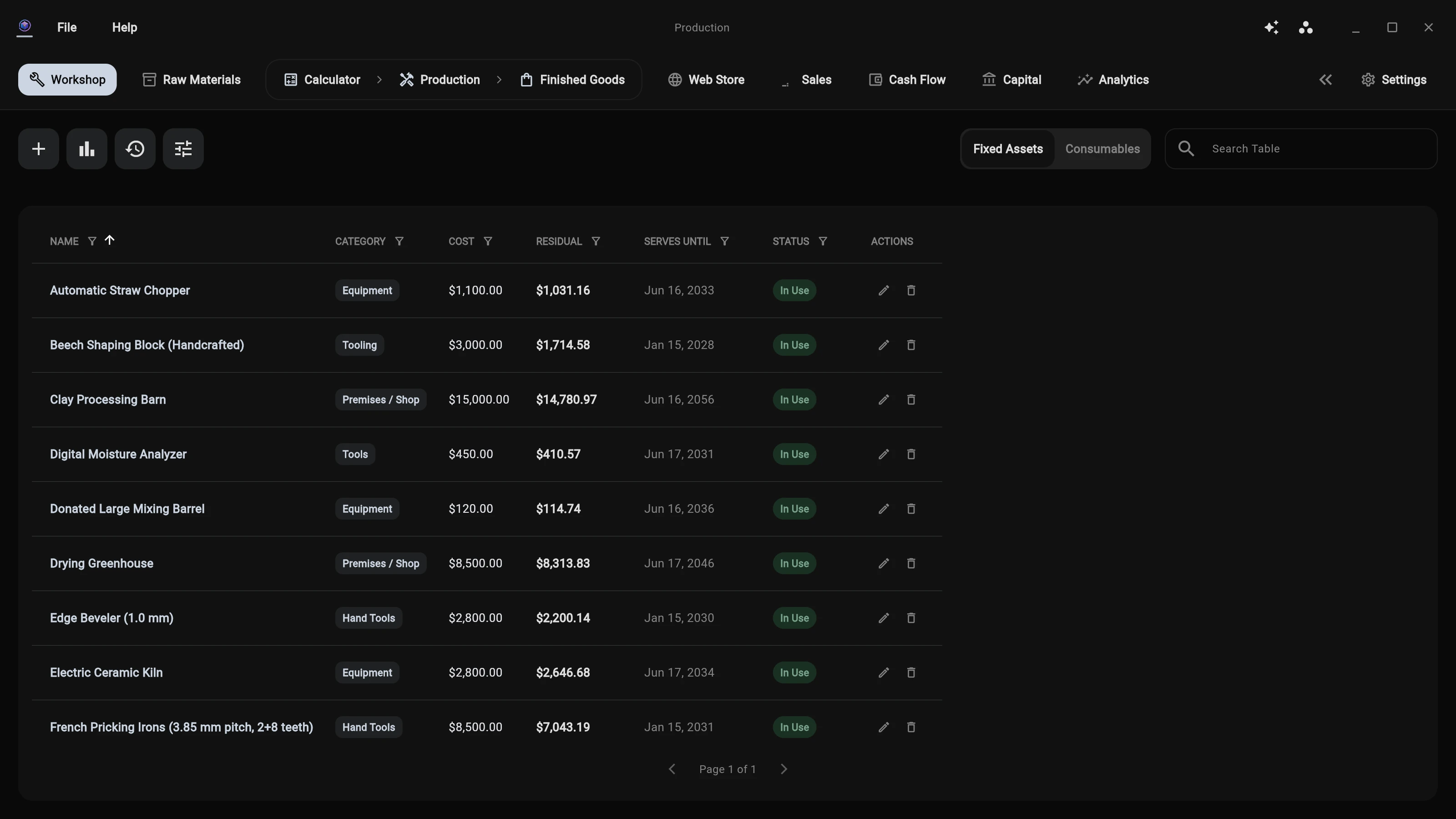
Before initiating the batch, we log the comprehensive tooling foundation of the workshop:
| Station & Equipment | Process Role | Asset Cost | Lifespan / Type |
|---|---|---|---|
| Cutting Station Japanese utility knife, A2 mat, 60 cm steel ruler | Precision hide cutting, outer shell and lining preparation | 3,200 ₽ | 3 years (fixed capital) |
| Pricking Station French pricking iron set (3.85 mm), polymer maul, punch board | Consistent stitch hole punching for hand saddle stitch | 5,800 ₽ | 3 years (fixed capital) |
| Stitching Station Solid beech stitching pony, John James needles (#4) | Part clamping and two-needle saddle stitching | 3,800 ₽ | 5 years (fixed capital) |
| Edge & Finishing Edge beveler (1.0 mm), creaser, rosewood slicker | Edge beveling, heat creasing, wax burnishing | 2,400 ₽ | 3 years (fixed capital) |
| Dedicated Tooling Custom wooden shaping block for zip clutch (beech) | Precise perimeter zipper cementing without distortion | 3,000 ₽ | 20 clutches (batch amortization) |
| TOTAL TOOLING CAPITAL | Assets in Workshop tab | 18,200 ₽ | Capital Base |
OmniCraft applies a clean structural distinction across assets:
- Core Hand Tooling (15,200 ₽):
Serves for years and is capitalized as fixed assets in Workshop and Capital, representing the maker's equity without requiring fractional depreciation per unit. - Dedicated Tooling (3,000 ₽):
The beech shaping block designed specifically for this clutch model is amortized directly over its production run (150 ₽ per clutch / 1,500 ₽ per 10-piece batch) and recouped into the tooling reserve fund with every sale.
Capitalizing the shaping block in the Workshop tab:
- Open the asset entry form:
Click «Add Asset» in the Workshop tab. - Complete the dedicated tooling fields:
- Asset NameWooden Shaping Block for Zip Clutch (Beech)
- CategorySpecial Tooling & Fixtures
- Initial Cost3,000 ₽
- Estimated Lifespan20 cycles (2 batches of 10 pcs)
- Cash Flow LinkingOwner Injection (Personal card)
How Fixture Amortization is Allocated to a Batch
The lifespan of the custom beech shaping block for this model is 20 clutches (2 batches of 10 units). A batch of 10 units consumes exactly half (1/2) of the tool's lifespan: 3,000 ₽ ÷ 20 = 150 ₽ per unit, or 1,500 ₽ ($18) for the entire 10-piece batch. This figure is automatically incorporated into the recipe card and accumulated in the workshop's equipment replacement reserve with every completed sale.
Step 2: Batch Material Procurement & Mixed Financing (Warehouse Tab)
The maker purchases leather, zippers, and edge finishing compounds using a personal credit or debit card. To preserve strict boundaries between personal wealth and workshop finances, procurement is logged through the standard owner investment entry.
Navigate to the Warehouse tab and click «Batch Material Purchase»:
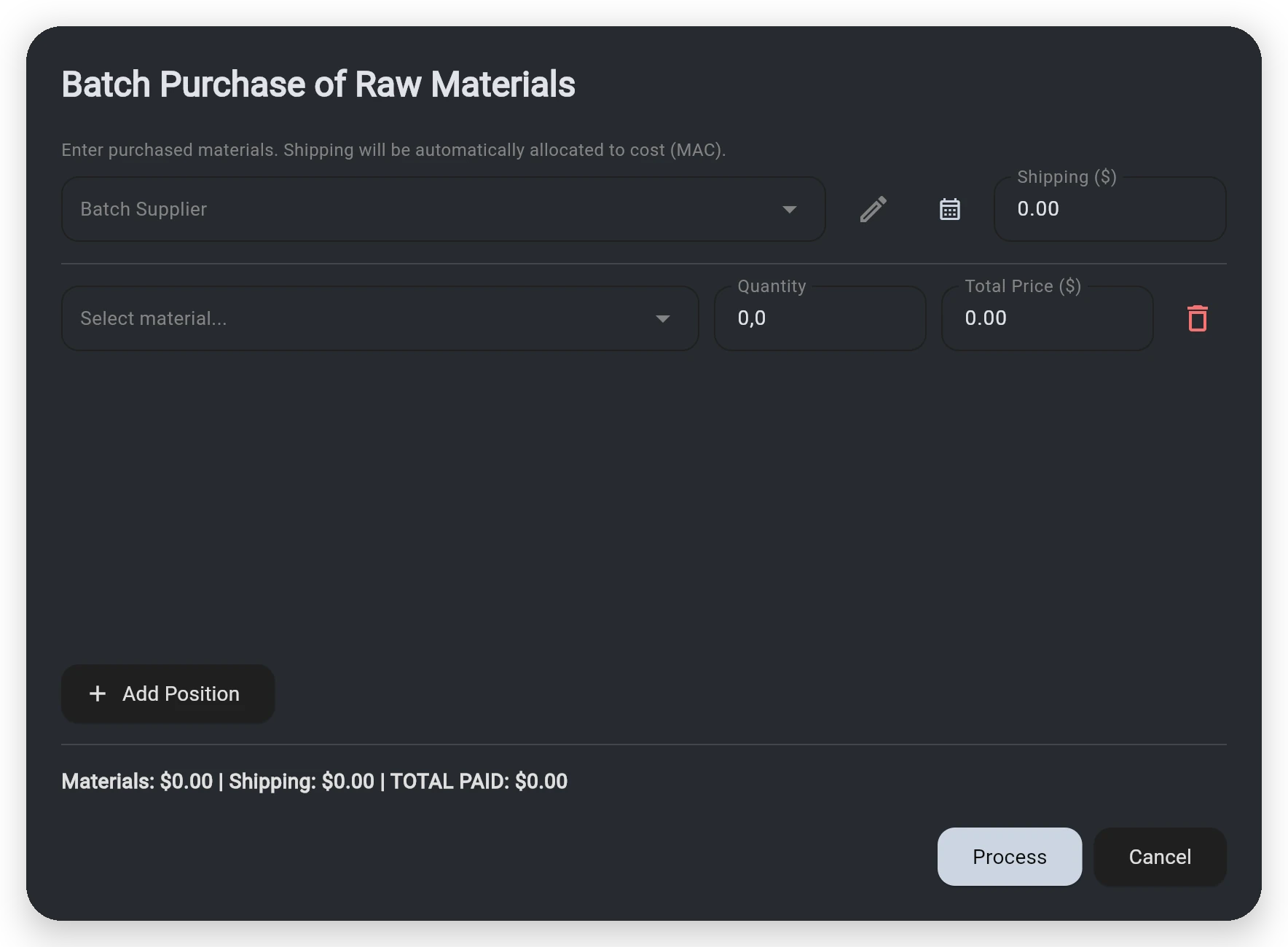
| Material / Components | Quantity & Rate | Total Cost | Payment Source |
|---|---|---|---|
| 1.5 mm Full-Grain Veg-Tan Leather | 150 sq. dm × 55 ₽ | 8,250 ₽ | Personal card |
| 0.9 mm Goat Chevre Lining Leather | 150 sq. dm × 45 ₽ | 6,750 ₽ | Personal card |
| #5 Metal Perimeter Zippers (48 cm, brass) | 10 pcs × 250 ₽ | 2,500 ₽ | Personal card |
| #3 Interior Coin Zippers (18 cm) | 10 pcs × 100 ₽ | 1,000 ₽ | Personal card |
| Consumables (SAR 306 cement, thread, Tokonole) | 1 kit (batch supply) | 1,500 ₽ | Personal card |
| TOTAL RAW MATERIAL COST | Complete Invoice | 20,000 ₽ | Owner Capital Deposit |
Click «Process». The software executes three operations simultaneously:
- Inventory Receipt:
Logs physical stock into inventory with exact units of measure (sq. dm, pieces, kits). - Moving Average Cost (MAC):
Establishes the moving average unit cost for each stock item across deliveries. - Startup Liability Tracking:
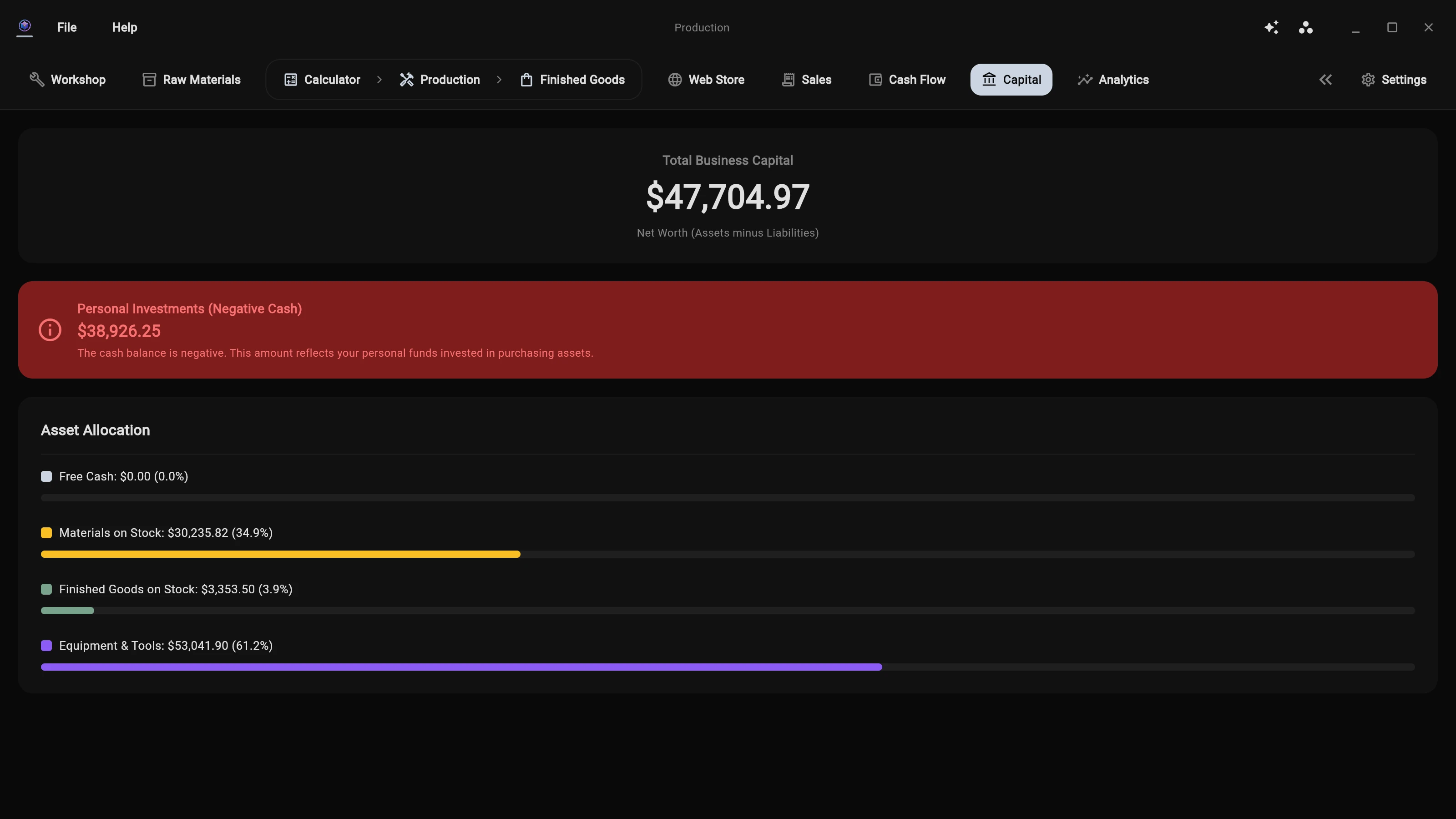
Registers a corresponding entry in Cash Flow under «Owner Capital Deposit» totaling 20,000 ₽ (plus 3,000 ₽ for equipment capitalized in Step 1). The workshop now formally records a 23,000 ₽ total liability to repay this invested startup capital after the batch is sold.
Step 3: Cutting Yield (Efficiency Rate) and Waste Accounting
Each natural hide possesses irregular contours, variable fiber density across topographical zones, and edge characteristics (flanks, neck wrinkles, healed marks).
When assembling structural zip clutches, exterior panels must be cut exclusively from the dense bend (butt) area to avoid deformation under zipper tension. Consequently, the material efficiency rate (yield) is 80%:
Cutting Balance for the Batch
- Purchased Exterior Hide Area150 sq. dm (55 ₽/sq. dm = 8,250 ₽)
- Net Cut Area for 10 Clutches120 sq. dm (12 sq. dm per clutch)
- Technological Offcuts (Scrap)30 sq. dm (20% trim rate)
The 30 sq. dm of secondary scraps are retained on the workshop balance sheet as «Usable Scrap Inventory» for small accessories (keychains, card sleeves, watch straps).
Scrap Accounting Options & Warehouse Inventory Reconciliation
When offcuts are not used for smaller goods: If your workshop does not produce keychains or cardholders and belly scraps are discarded, do not capitalize them as usable scrap. Instead, enter the gross consumption rate into the recipe card: 150 sq. dm ÷ 10 pcs = 15 sq. dm per clutch (825 ₽ instead of 660 ₽), fully allocating the entire hide cost to the batch.
Reconciling scrap variances via Inventory Act: Natural hides vary in usable area, and cutting yield can fluctuate across batches. If a variance gradually accumulates between the software's recorded stock and the physical scraps on your shelf, open the Warehouse tab, launch an «Inventory Act», and write off the shortage or record surplus stock in a single step — the system automatically reconciles your inventory asset value.
Step 4: Product Recipe Card & Costing (Calculator Tab)
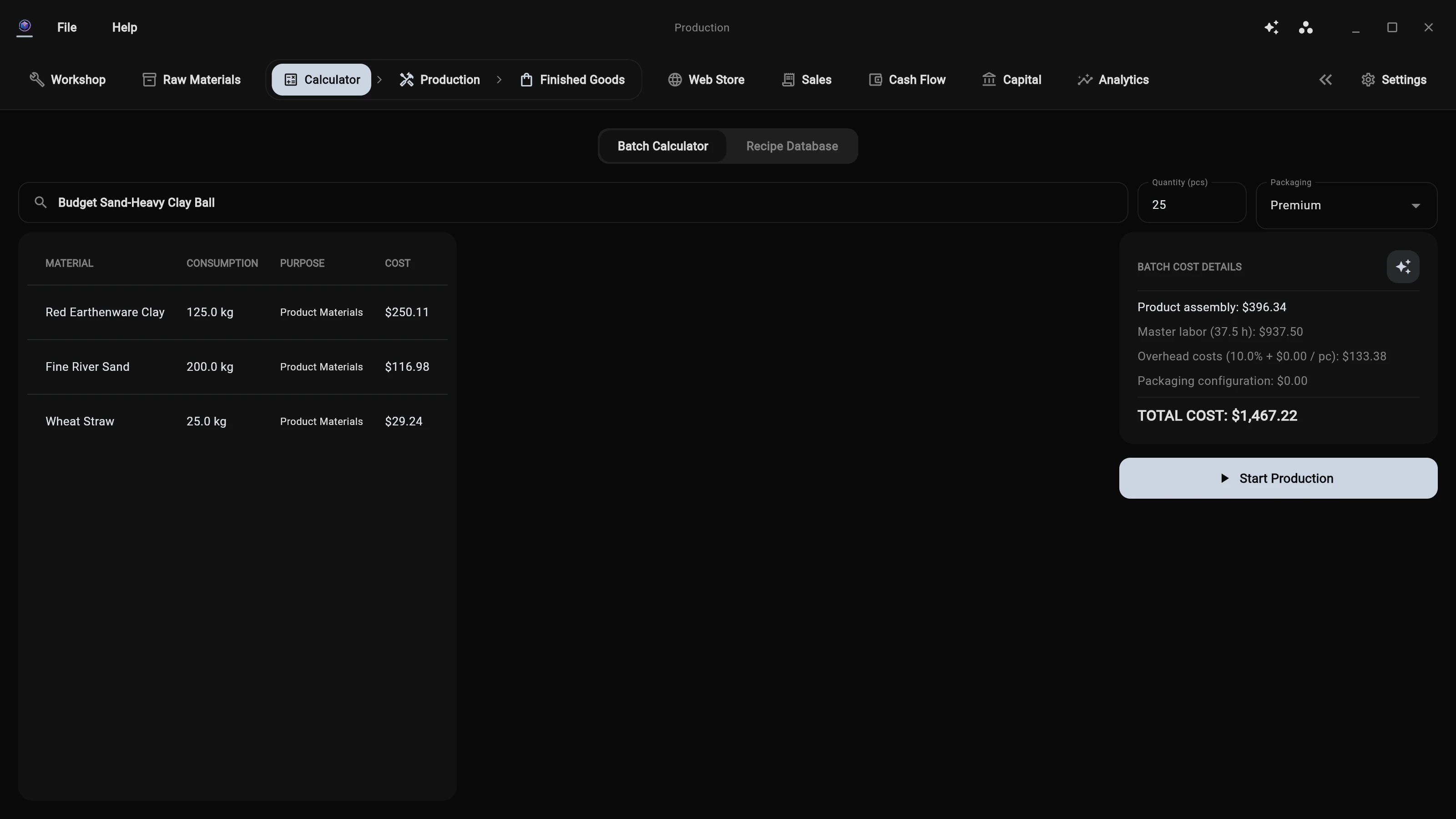
Under the Calculator tab, we create the full technological recipe card for the clutch. Every direct material, fixture amortization, and craftsman labor hour is documented:
| Cost Element | Consumption & Rate | Per 1 Clutch | Share |
|---|---|---|---|
| Exterior Veg-Tan Leather (1.5 mm) | 12 sq. dm (yield-adjusted) × 55 ₽ | 660 ₽ | 15.2% |
| Interior Chevre Leather (0.9 mm) | 14 sq. dm (lining + slots) × 45 ₽ | 630 ₽ | 14.5% |
| #5 Perimeter Zipper (48 cm) | 1 pc × 250 ₽ | 250 ₽ | 5.8% |
| #3 Coin Pocket Zipper (18 cm) | 1 pc × 100 ₽ | 100 ₽ | 2.3% |
| Cement, Thread & Edge Finishes | 1 consumables pack × 150 ₽ | 150 ₽ | 3.5% |
| Beech Shaping Block Amortization | 1/20 lifespan of 3,000 ₽ | 150 ₽ | 3.5% |
| TOTAL DIRECT MATERIAL & TOOLING | Raw materials & fixtures | 1,940 ₽ | 44.8% |
| Craftsman Labor Allocation | 6.0 hours × 400 ₽ / hour | 2,400 ₽ | 55.2% |
| TOTAL COST OF GOODS SOLD (COGS) | Final unit cost base | 4,340 ₽ | 100.0% |
Pricing and Business Markup
- Base Unit Cost (COGS)4,340 ₽
- Business Markup (+105%)4,560 ₽
- Recommended Retail Price8,900 ₽
Craftsman Labor Wage & Enterprise Markup
The craftsman's direct labor allocation (2,400 ₽ for 6 hours of saddle stitching and edge creasing) constitutes guaranteed operational wage compensation. Net enterprise profit is generated separately via the business markup (+105%), ensuring a clear boundary between personal craftsman income and business equity.
Step 5: Batch Production & Inventory Depletion (Workbench Tab)
With the recipe finalized, we launch the 10-piece production run:
- Specify batch volume:
In the recipe card, set Batch Quantity: 10 pcs. - Start production run:
Click «Start Production». - Automated stock reservation & depletion:
OmniCraft automatically allocates raw materials from inventory:- 120 sq. dm veg-tan hide
- 140 sq. dm chevre lining
- 10 #5 + 10 #3 zippers
- Thread, cement & Tokonole
- Active workbench tracking:
The batch appears on the active Workbench view as «Batch #101: Zip Clutch (10 pcs)».
Shortage Guard: Preventing "Blind" Batch Production
Before cutting valuable hides, OmniCraft automatically audits current stock availability for the entire planned batch. If even a single component is insufficient (for example, having only 8 perimeter zippers instead of 10), the software displays a shortage alert detailing the exact missing materials and highlighting the deficit. The maker can immediately log a quick purchase order or adjust the batch quantity to match available stock.
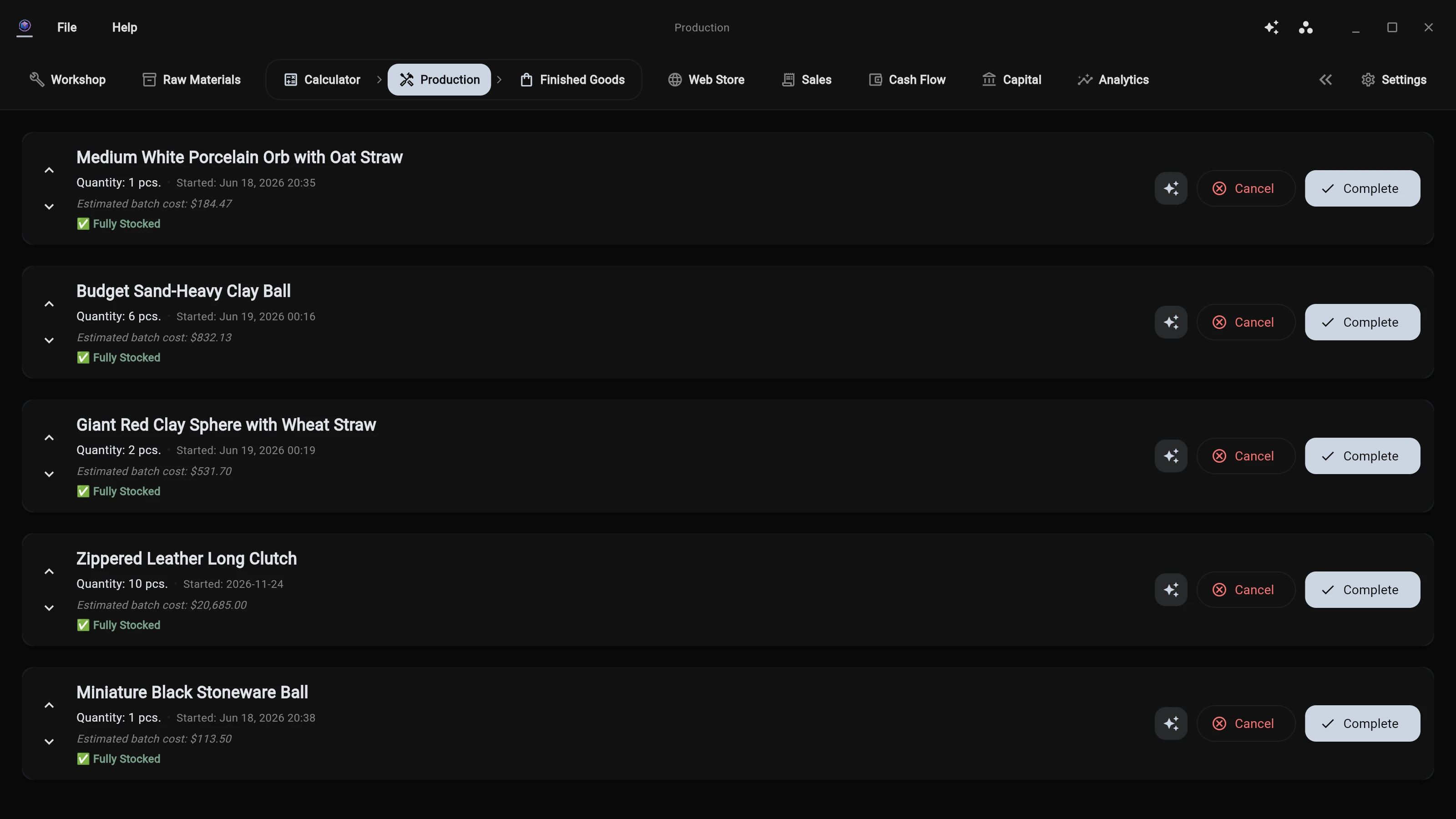
Production proceeds through distinct operations: rough cutting ➔ edge skiving ➔ card slot pocket assembly ➔ wooden block zipper mounting ➔ pricking and hand saddle stitching ➔ 3-stage edge burnishing.
Upon completion, clicking «Complete» transfers 10 finished clutches directly to the Products Showcase inventory at a capitalized balance of 4,340 ₽ each (total finished goods asset value: 43,400 ₽).
Step 6: Sales Realization & Reconciled P&L Statement
The batch of 10 clutches is sold through direct craft channels and bespoke commissions at the retail price of 8,900 ₽. Over a three-week window, all 10 clutches are delivered and logged in the Sales module.
The diagram below maps the complete flow of funds and final financial reconciliation.
Reconciled Batch Profit & Loss Statement
| Financial Line Item | Per Unit | 10-Pc Batch | Allocation Destination |
|---|---|---|---|
| Gross Sales Revenue | 8,900 ₽ | 89,000 ₽ | Received into workshop business account / cash |
| Material & Hardware Repayment | −1,790 ₽ | −17,900 ₽ | Returned to maker's personal card (material recovery) |
| Tooling Replacement Reserve | −150 ₽ | −1,500 ₽ | Tooling reserve fund (50% amortized / 1,500 of 3,000 ₽) |
| Craftsman Wage Allocation | −2,400 ₽ | −24,000 ₽ | Maker's personal compensation (60 hours of labor) |
| Flat Activity Tax (6%) | −534 ₽ | −5,340 ₽ | Paid to tax authorities |
| NET ENTERPRISE PROFIT | +4,026 ₽ | +40,260 ₽ | Retained workshop capital (volume leather buy, growth) |
Summary: 5 Maker Pains Resolved
Five critical workshop vulnerabilities systematically resolved across a single 10-clutch production run:
- Transparent Costing (P-01):
Thread, edge finishes, reinforcement liners, and fixture amortization are accurately budgeted into unit cost (1,940 ₽ materials & tooling + 2,400 ₽ labor). Step 4: Product Recipe Card - Untangled Personal & Business Finances (P-02):
Direct batch expenses (17,900 ₽ in consumed materials + 1,500 ₽ fixture amortization = 19,400 ₽) were completely reimbursed to the maker's card with zero cash strain, while the remaining 3,600 ₽ in initial capital remains safely capitalized on balance (2,100 ₽ in usable leather offcuts and 1,500 ₽ in remaining shaping block asset value; 19,400 ₽ + 3,600 ₽ = 23,000 ₽ total balance reconciliation). Step 2: Mixed Capital Accounting - No Intimidating Bookkeeping (P-03):
Zero accounting jargon — intuitive Warehouse, Calculator, and Workbench interfaces. Step 5: Production Cycle - Controlled Offcut Value (P-04):
30 sq. dm of usable offcuts remain capitalized in raw inventory for smaller leather goods. Step 3: Cutting Yield & Scrap - Rock-Solid Pricing Confidence (P-05):
The 8,900 ₽ retail price is backed by exact math: 24,000 ₽ in take-home wages for labor, plus 40,260 ₽ in net retained profit. Step 6: Reconciled P&L Statement
Troubleshooting & Batch Pitfalls
What if a pattern piece or leather panel is ruined during cutting or punching?
If an exterior panel is damaged and needs recutting, navigate to the "Raw Materials" tab and record an inventory write-off for the additional leather area noting "Scrap piece in batch ORD-0001". Moving Average Cost (MAC) will absorb the expense, ensuring adjusted batch unit costs reflect real-world workshop yield without distorting physical inventory balances.
What if actual consumption of adhesives, thread, or finishes exceeds recipe estimates?
In OmniCraft ERP, auxiliary shop consumables are handled either via direct volume deduction or as an overhead percentage. If extra edge paint or cement was consumed, deduct it on the "Raw Materials" tab and bump the product's overhead allocation percentage in the "Calculator" for future runs to cover actual shop appetite.
What if the client requests different hardware while the batch is already In Production?
On the "Workbench" tab, click the "Cancel Task" button (red cross icon). All reserved materials, zippers, and fittings immediately return to raw inventory. Update the recipe in the "Calculator" (switch sliders or zipper colors) and relaunch the run.
Start running transparent accounting in your craft workshop
Download OmniCraft ERP for Windows. Runs completely locally on your computer, protects your business data privately, and requires zero monthly subscriptions.
Getting Started Guide
Step-by-step setup instructions, workshop profile configuration, and launching your first production batch.