
The Leather Scrap Trap: True Cutting Yield and Usable Hide Area
When buying an 18 sq ft half-hide, a leatherworker might plan to produce 10 tote bags requiring 1.5 sq ft each (15 sq ft total) and assume the remaining 3 sq ft will be pure safety stock.
In reality, after cutting the sixth bag, large defect-free panels are nowhere to be found. The cutting table is left with angular wedges, spongy belly strips, and scarred flanks. Between 20% and 35% of the hide's purchased area ends up in the scrap bin.
This is the classic "scrap trap." Let's examine hide anatomy, zonal topography, precise cutting yield coefficients, and scrap inventory mathematics.
1. Anatomical Topography: Why Leather is Non-Uniform
Unlike woven textile or plastic sheets, genuine leather is a biological material with variable density, thickness, and fiber stretch directions.
A cattle hide is divided into four basic anatomical zones with distinctly different properties:
| Hide Zone | Area Share | Fiber Structure | Elasticity / Stretch | Product Application |
|---|---|---|---|---|
| Croupon / Butt | 45–55% | Maximum density, tightly interlocked dermal fibers | Minimal, stable stretch | Bag outer panels, belts, structural load points |
| Neck / Shoulder | 20–25% | High tensile strength, pronounced grain wrinkles | Stretches across spine line | Internal partitions, straps, small goods |
| Belly | 15–20% | Loose fiber network, softer temper | Stretches in all directions | Hidden layers under fabric lining, gusset backing |
| Flank | 5–10% | Very loose, thin, rubbery deformation | Unstable temper | Technical waste, test patches, dye swatches |
Beware the Economy Grade Illusion
Novice crafters often buy economy grade sides (Grade 3–4) at cheap square foot rates, hoping to produce luxury bags. But in lower grades, the prime butt area is riddled with barbed wire scars, fire brands, and grub holes. As a result, usable yield plummets to 50%, making the effective cost per usable foot significantly higher than a Grade 1 premium croupon.
2. Yield Matrix: Realistic Material Utilization Rates
To avoid guesswork when planning batch production, professional workshops apply the Material Utilization Coefficient (MUC).
MUC values depend directly on two factors: the anatomical zone and part dimensions.
| Product Type / Part Dimensions | Butt | Shoulder | Belly | Average MUC | Cutting Loss |
|---|---|---|---|---|---|
| Large panels (backpacks, messenger bags, totes) Parts ≥ 1.5–3 sq ft | 0.85–0.88 | 0.70–0.75 | 0.50–0.55 | 0.70 | 28–32% |
| Medium panels (clutches, long wallets, A4 folios) Parts 0.3–0.8 sq ft | 0.88–0.92 | 0.78–0.82 | 0.60–0.65 | 0.78 | 20–24% |
| Small goods (bifolds, minimalist cardholders, key tags) Parts ≤ 0.1–0.2 sq ft | 0.92–0.95 | 0.85–0.88 | 0.70–0.75 | 0.86 | 12–16% |
Golden Workshop Rule
When quoting a leather bag, always budget a standard MUC = 0.70. If your pattern templates measure 3.5 sq ft clean, you must purchase and deduct:
3.5 ÷ 0.70 = 5.0 sq ft of hide.
3. Cutting Economics: Effective Price per Usable Unit
Let's look at the financial disparity between novice cost estimation and rigorous shop accounting.
Case Study: Handcrafted Leather Tote Bag
- Procurement baseline: 16 sq ft side at $9.00/sq ft (total hide cost: $144.00). Finished bag pattern area: 7.0 sq ft clean.
- Novice calculation (ignoring MUC): 7.0 sq ft × $9.00 = $63.00. The maker assumes $81.00 of prime leather remains untouched in inventory.
- True production calculation (MUC = 0.68): 7.0 ÷ 0.68 = 10.3 sq ft committed to the job. Perimeter trim, flanks, and corner drops consume 3.3 sq ft. Actual leather cost: 10.3 × $9.00 = $92.70.
The Phantom Profit Leak
The difference is $29.70 in pure unrecovered loss on every single tote bag. At a modest volume of 10 bags per month, that amounts to $297.00 every month ($3,564.00 annually) drained straight from maker profits.
4. How to Account for Scrap: The Moving Average Cost (MAC) Method
What happens to the remaining 3.3 sq ft of offcuts? Leaving them on the balance sheet at the full $9.00/sq ft purchase price distorts your inventory: they cannot be resold at that price and cannot yield large bag panels.
Complete Scrap Monetization Guide
For an in-depth breakdown of 5 scrap monetization business models, a small goods matrix with time and footage benchmarks, and the 6-Month Liquidation Rule, explore our companion guide: What to Do with Leather Scraps: 5 Monetization Models & Remnant Inventory.
Professional leather ateliers divide scrap into two distinct inventory categories:
- Fraction 1: Technical Waste (pieces < 0.2 sq ft / 2 dm²): written off at $0.00. Its full financial cost is absorbed into the primary product (the tote bag).
- Fraction 2: Usable Remnants (uniform shapes ≥ 0.2 sq ft / 2 dm²): added to inventory at a discounted valuation factor (0.40–0.50). At a $9.00 baseline, they enter stock at $4.00–$4.50/sq ft. These scraps produce high-margin key fobs, cable straps, and cardholders.
5. Workshop Checklist: 10 Cutting Rules at the Bench
Follow this operational protocol to minimize waste and avoid costly cutting defects:
- Inspect the hide before the first strike: map all blemishes with a silver marking pen (healed scars, insect bites, tanner marks). Add a 0.5-inch perimeter margin to prevent defects on visible panels.
- Respect the spine line: align structural load parts (straps, handles, belts) parallel to the backbone. Leather stretches 15–25% more perpendicular to the spine.
- Cut largest patterns first: begin with main body panels and gussets. Fill interstitial voids with small components like pockets, card sleeves, and keepers.
- Maintain a strict 90° blade angle: tilting your rotary or round knife produces beveled edges. Glued edge joints will step out of alignment, requiring excessive sanding.
- Use a firm, rigid cutting mat: cut only on self-healing mats or dense vinyl blocks. Soft backing flexes under pressure, distorting acrylic template perimeters.
- Belly is strictly for secondary components: never use belly cuts for exterior wallet shells or watch straps. They will stretch and wrinkle within weeks of regular use.
- Compensate fold thickness: when cutting wrapped edges or tight bends, add clearance based on material thickness:
Δ = 2 × Leather Thickness. - Skive edge margins prior to assembly: reduce edge thickness by 50% along seam allowances using a French skiving tool or Japanese utility blade.
- Balance symmetrical parts: cut paired bag gussets symmetrically across the spine line so both sides respond identically to humidity and tensile load.
- Sort offcuts immediately at the bench: maintain dedicated bins for reusable scrap (≥ 0.2 sq ft) and discard waste to maintain workshop order.
6. Frequently Asked Questions (FAQ)
How do I calculate leather consumption for a bag without a final pattern?
Calculate the gross rectangle area of the primary panels (length × width of front, back, bottom, and gussets) and add 15% for handles, internal pockets, and seams. Divide the result by the standard benchmark MUC = 0.70:
For a bag measuring 3.0 sq ft clean, budget at least 4.9 sq ft of purchased hide to absorb inevitable cutting losses.
Why is butt/croupon leather 2–3× more expensive than belly?
The croupon is the densest section of the hide with tightly interwoven collagen fibers. It demonstrates minimal elongation, uniform thickness, and superior abrasion resistance. Belly fibers are loose, spongy, and deform under modest tensile stress.
Can belly leather be used for card slots?
Only when reinforced with fabric or non-stretch lining. Exposed belly card slots deform rapidly under repeated card extraction friction.
How should scrap costs be built into retail pricing?
Divide net pattern footage by your benchmark MUC coefficient (0.68–0.70 for bags, 0.85 for small goods) and multiply by invoice price per unit:
Alternatively, multiply net pattern area by the effective usable cost per unit: Apattern × (Purchase Price ÷ MUC).
7. Workshop Automation: OmniCraft ERP
Tracking cutting coefficients, offcut batches, and effective costs in paper logs or complex spreadsheets is slow and error-prone.
When a studio stocks 5 leather varieties at different unit costs and offcuts roll over across custom orders, manual tracking consumes hours of unbillable time.
Professional production software links cutting yields, inventory batches, and cost of goods sold into a single automated system:
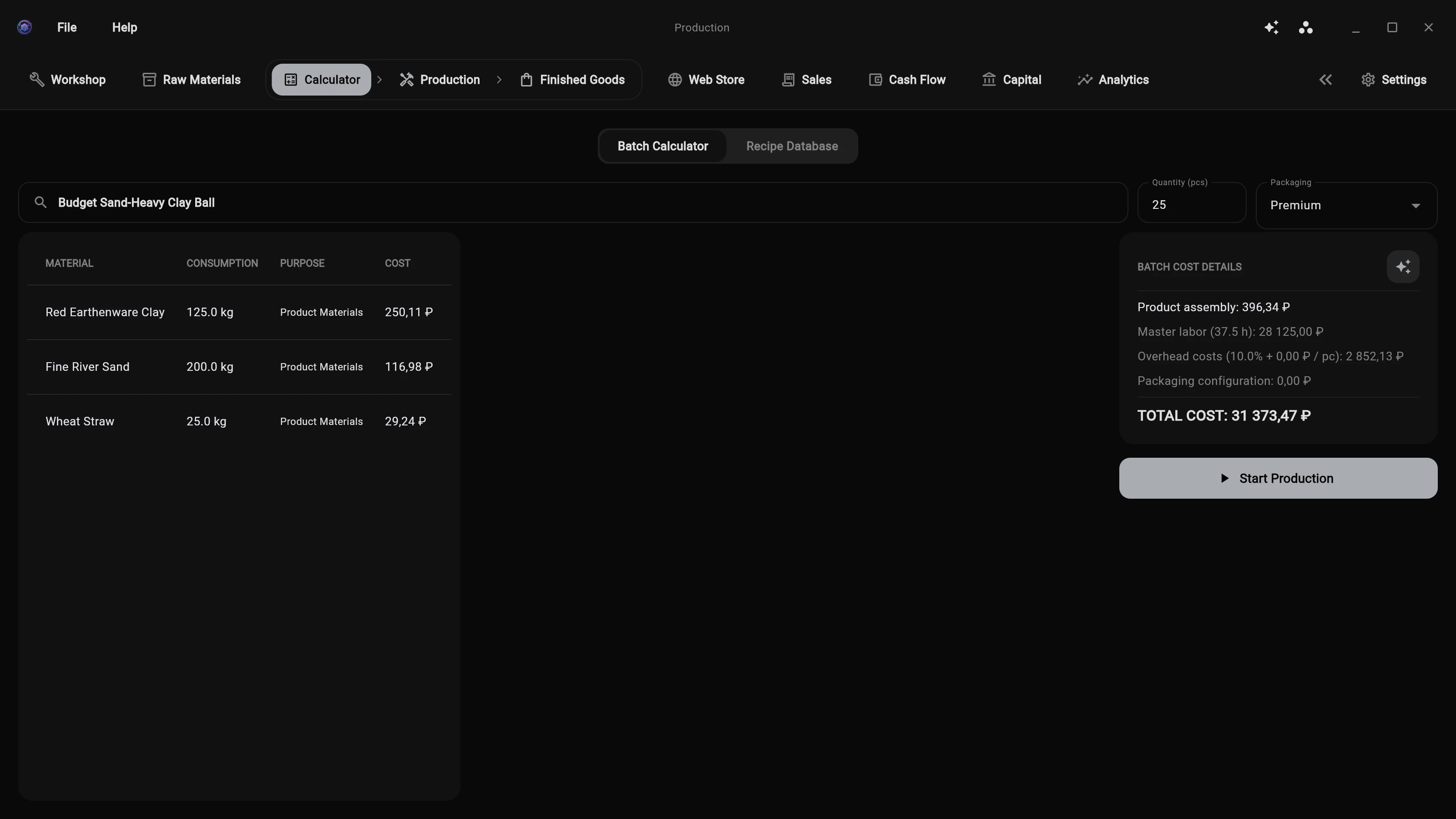
In OmniCraft ERP, the job estimation engine automatically computes usable leather yields via MUC coefficients, tracks capitalized scrap using MAC inventory accounting, and protects true gross profit margins.
OmniCraft ERP for Makers
Automatic yield coefficient tracking, MAC inventory for reusable leather offcuts, and precise labor rate calculations.
Leather Cost Calculator
Calculate true leather consumption online accounting for offcut waste, edge chemistry, hardware, and export estimates to Excel.
Related Manufacturing & Economics Guides
- Leather Consumption: Formula & Yields for Bags, Wallets, Belts — exact sq ft and sq dm consumption table across 9 products, gravimetric pattern measurement, and unit conversion.
- What to Do with Leather Scraps: 5 Monetization Models & Remnant Inventory — craft workshop monetization strategies, micro-product matrix, and scrap inventory liquidation.
- Online Leather Goods Cost Calculator — interactive estimation of usable hide footage, edge paint, hardware, and shop labor rate.
- Pricing, Markup, and Margin: How to Never Sell at a Loss — flagship guide to craft retail math, profit margins, and breakeven volume.
- Cost Calculation Software for Workshops — architectural comparison of spreadsheets, monolithic ERPs, and specialized craft tooling.
- Universal Product Cost Calculator — calculate per-unit costs with scrap margins and Excel estimate exports.
- All Production Calculators — industry-specific financial tools for 7 craft disciplines.