
Capital: Business Balance Sheet
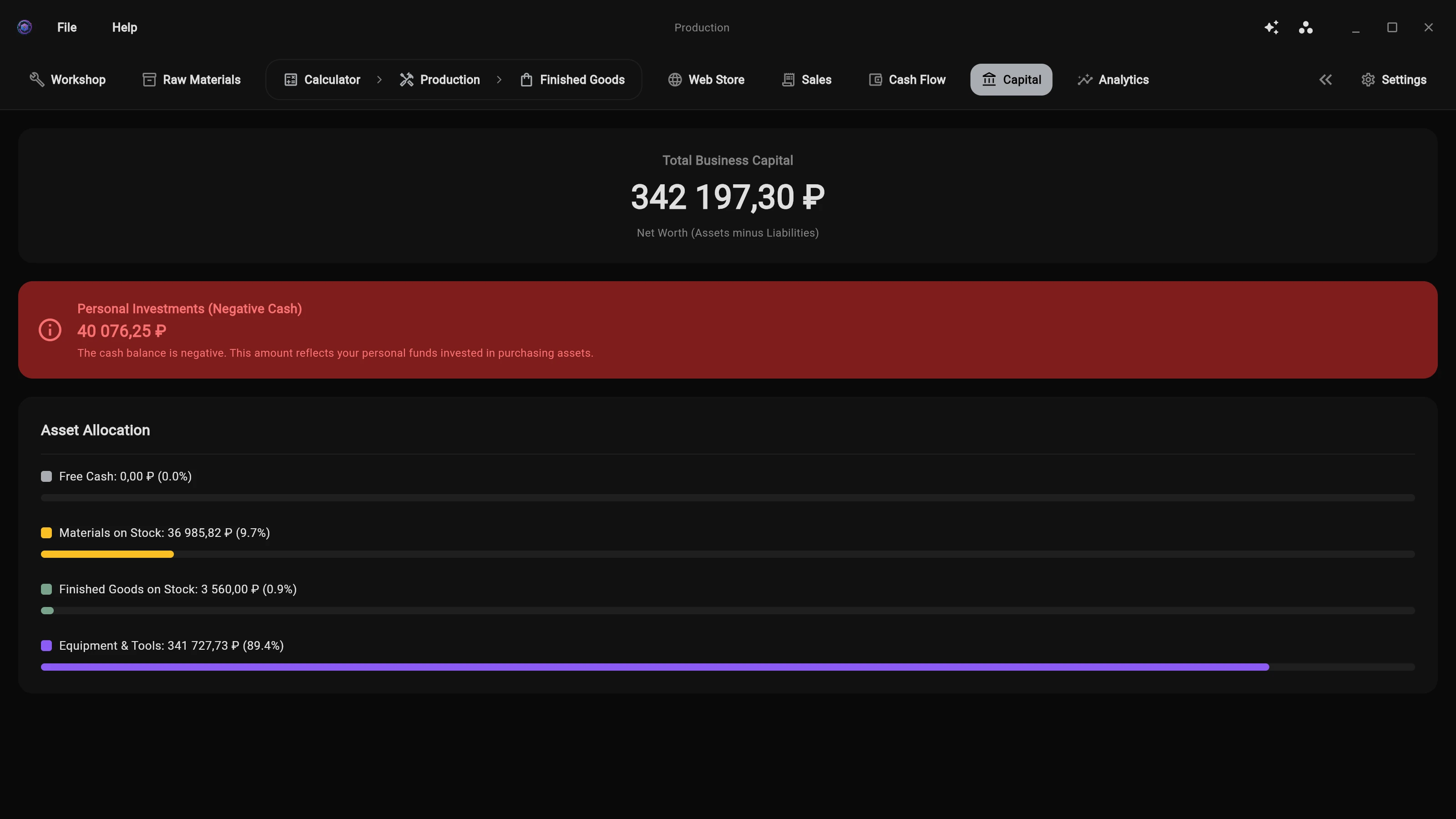
The "Capital" tab serves as the real-time financial compass for your enterprise. While the Cash Flow ledger (DDS) answers the operational question "Will we have enough cash for tomorrow's bills?", the Capital statement answers the founder's ultimate strategic question:
"What is my entire business genuinely worth right now, if all assets are valued and obligations settled?"
Here, the system consolidates physical machinery, warehouse materials, finished inventory, and available liquidity, deducting outstanding liabilities to determine your Owner Equity (Net Assets).
Mathematical Model: Net Asset Equation
The module operates on the fundamental equation of managerial accounting:
Reflects the true net value of your enterprise after deducting liabilities, even when liquid cash is temporarily tight.
As long as owner equity remains positive and steadily expands month over month, your enterprise is compounding value, even if liquid cash in your account or cash drawer is temporarily tight.
Conservation and Circulation of Value
In everyday life, spending money is often perceived as a loss. In professional accounting within OmniCraft ERP, assets undergo continuous transformation:
- Funds Do Not Disappear; They Change State:
- Cash on Hand:
Initial liquid capital or received client deposits in the cash ledger. - Warehouse Inventory (MAC):
Stock purchases and batch intake evaluated via moving average cost. - Work in Progress:
Component deduction on the workbench and labor hour logging. - Finished Goods (FIFO):
Completed production booked into stock with permanently frozen unit cost. - Cash Return with Net Margin:
Customer sale execution, cashier receipt settlement, and profit realization.
- Depreciation as Investment Recovery: long-term machinery progressively transfers its book value into the unit cost of products and services via overhead wear rates. These funds return to cash upon sales, building the replacement reserve for capital assets.
Four Balance Sheet Aggregates (Asset Breakdown)
Beneath the primary capital figure, visual progress bars display in what form your business capital is currently deployed:
1. Liquid Cash (Treasury)
The actual positive cash balance across bank accounts and cash drawers. This is the most agile asset class, ready for immediate raw material orders, tax payments, or owner dividend withdrawals.
2. Warehouse Materials and Supplies
The valuation of all on-hand materials calculated using the Moving Average Cost (MAC) method. The system accounts for real supplier invoices and freight shipping allocations, reflecting fair warehouse equity.
3. Finished Goods and Completed Services
- In manufacturing: completed inventory in stock, valued strictly at batch production cost (discharged under the FIFO method).
- In the service sector: completed or closing work orders reflecting installed replacement parts and billable technician labor.
4. Machinery and Long-term Assets
The residual book value of all active machines, specialized tools, workstations, diagnostic instruments, and shop furnishings after cumulative straight-line depreciation.
Founder Investments: Negative Cash on the Balance Sheet
During business setup or shop expansion, a dedicated line item may appear within the asset breakdown: "Owner Investments".
| Balance Sheet Line Item | Amount, $ | Economic Role |
|---|---|---|
| Machinery & Equipment | $15,000 | Depreciated book value of fixed assets |
| Raw Materials Inventory | $5,000 | Warehouse materials valued via MAC |
| Finished Products in Stock | $2,000 | Finished batches tracked via FIFO |
| Owner Funding (Negative Cash Flow) | −$7,000 | Founder capital invested into shop launch |
| Total Net Capital | $15,000 | Net equity valuation of the enterprise |
Economic Logic of Founder Capital:
- In our mixed finances approach, a negative cash ledger records a verifiable fact: the founder funded tool purchases or shop supplies out of personal funds.
- On the balance sheet, this amount stands as an obligation owed by the enterprise back to the creator.
- Once sales proceeds surpass initial outlays and the Cash Flow balance crosses into positive territory, the Owner Investments line item clears automatically, and subsequent net profits contribute directly to equity expansion.
Balance Sheet Patterns Across Sectors
While the underlying formula is universal, asset allocation depends directly on your operational model:
In Manufacturing and Artisan Crafts
- Balance Sheet Character: capital-intensive and inventory-heavy.
- Core Value Centers: heavy equipment with multi-year lifespans, bulk raw material reserves, and batch goods awaiting dispatch.
- Management Focus: preventing warehouse stockpiling when finished inventory turnover slows down.
In the Service Sector and Repair Centers
- Balance Sheet Character: technician workstations and revolving components.
- Core Value Centers: diagnostic stations, soldering complexes, lifts, service kits, and active work orders.
- Management Focus: aligning spare parts inventory with customer service intake volume.
In E-Commerce and Marketplace Sellers
- Balance Sheet Character: high-velocity commercial inventory.
- Core Value Centers: packaged inventory batches, shipping supplies, and compact labeling hardware (thermal printers, barcode scanners).
- Management Focus: preserving rapid inventory turns without holding stagnant stock keeping units.
For Independent Artisans and Solo Makers
- Balance Sheet Character: lean personal toolkit.
- Core Value Centers: precision hand tools and a curated working supply of materials without debt burdens.
- Management Focus: maintaining a transparent boundary between personal savings and workshop capital.
The Financial Triad: Capital, Cash Flow, and Analytics
To make sound executive decisions, recognize the roles of the three reporting tools:
| Dimension | Cash Flow (DDS) | Capital (Balance Sheet) | Analytics (Profitability) |
|---|---|---|---|
| Primary Question | Do we have enough cash for bills tomorrow? | What is the total enterprise worth right now? | What is our margin and revenue trajectory? |
| Measurement Method | Physical cash inflows and outflows (cash basis) | All assets, inventory, and goods minus liabilities | Sales velocity, receipt sizes, and line profitability |
| Owner Objective | Eliminate cash flow shortages | Grow the net worth of the business | Scale profitable lines and discontinue loss-making items |
Five Practical Realities for Business Owners
Mastering balance sheet mechanics protects founders from false assumptions during routine operations:
Reality 1: Cash is Low, Yet the Business is Wealthier
- Context: You spent $2,000 from accounts on a precision CNC laser or purchased a year's supply of brass fittings at a volume discount.
- In Cash: Liquid funds appear depleted.
- On the Balance Sheet: Net equity has not diminished by a cent; with a wholesale discount, it has actually grown. Liquid funds converted into productive machinery that compounds earnings over years.
Reality 2: Cash is Plentiful, Yet Capital is Eroding
- Context: You ran a clearance sale below unit manufacturing cost to generate quick cash, while shop machinery operates without planned maintenance.
- In Cash: Temporary liquidity surge.
- On the Balance Sheet: Equity is deteriorating: warehouses emptied at a net loss, and no depreciation reserve exists to replace aging equipment.
Reality 3: Material Scrap and Natural Wastage
- Context: Damaged raw material or defective components are discarded under a write-off report.
- Cash Flow Impact: $0 (no cash leaves the register).
- Capital Impact: Inventory value decreases by the written-off amount, maintaining a truthful asset valuation.
Reality 4: Enterprise Valuation for Partnerships
When pitching an investor, negotiating equity splits, or preparing to transfer an operating shop, the Capital tab delivers an audit-ready, documented summary of tangible enterprise worth without inflated speculation.
Reality 5: Equity Consolidation in PRO Mode
For advanced operations, individual workspace balances synchronize directly into the "My Capital" module. There, business balance sheets consolidate alongside personal bank accounts, real estate holdings, investment portfolios, and currency reserves for holistic wealth management.
Financial Hygiene: The First-of-the-Month Review
Sustained control does not require hours of daily bookkeeping.
The First-of-the-Month Rule
Make it a routine habit to inspect the "Capital" tab on the first day of each month and record the headline figure.
- If equity steadily trends upward month over month, your enterprise is compounding strength on a solid foundation.
- If high sales coincide with flat or declining capital, audit warehouse inventory for stagnant stock and verify that equipment wear rates are properly factored into pricing.