
Capital Dashboard: Consolidated Wealth Command Center
The Capital Dashboard tab serves as the primary executive bridge in the "My Capital" workspace. It executes end-to-end consolidation across isolated database files from every manufacturing workshop, service studio, and personal financial account, delivering a crystal-clear operational answer to the artisan's foundational question: what is the true combined market value of your craft business and personal assets right now.
The dashboard unifies dispersed financial streams into a unified coordinate system, dismantling classic accounting illusions: the mistaken sense of poverty during substantial investments in raw materials or machinery, or the illusion of sudden riches when customer order retainers accumulate temporarily in your bank account.
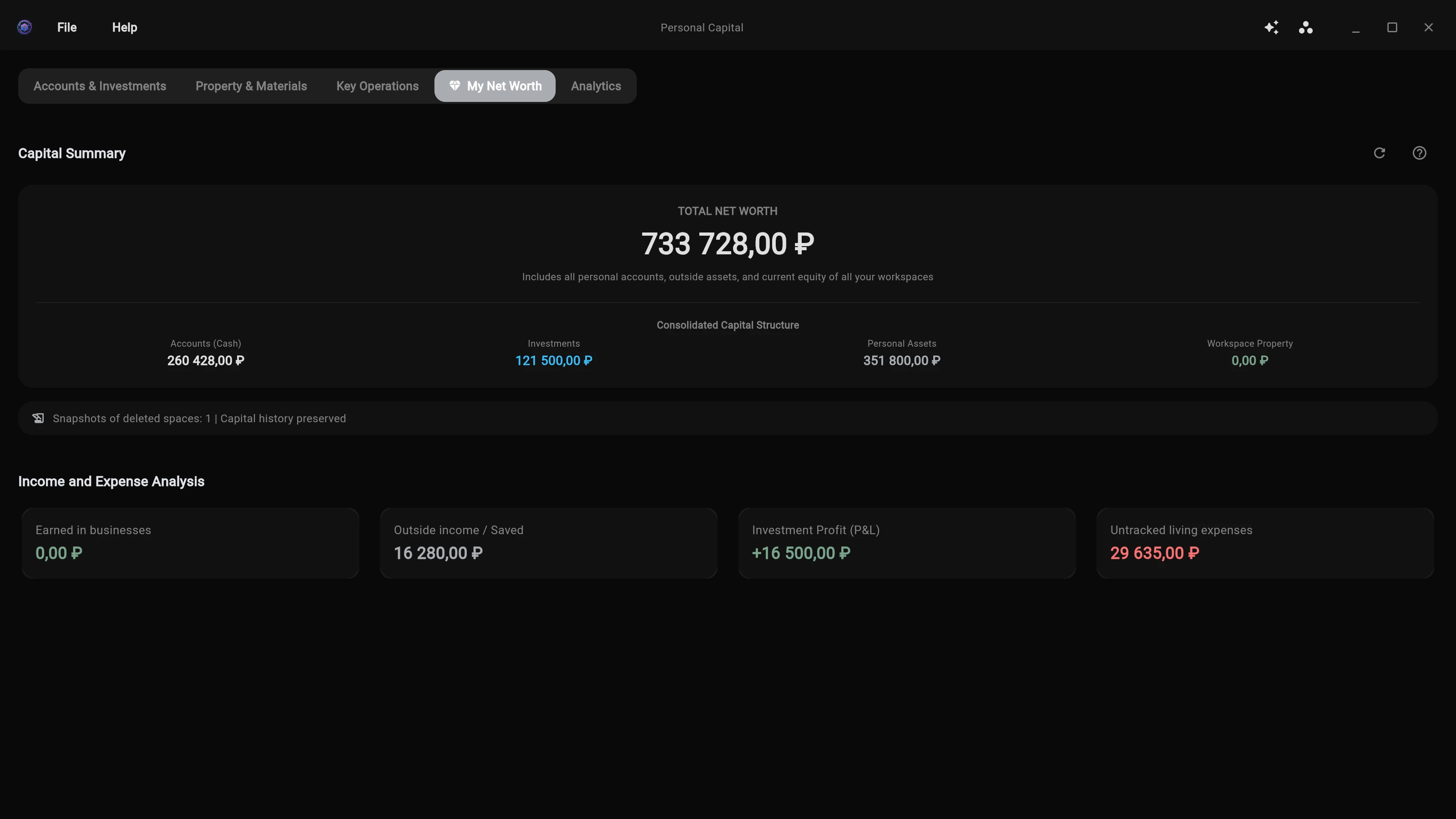
Four Pillars of Consolidated Net Worth
Total wealth in OmniCraft ERP rests upon four fundamental asset pillars. Each fulfills a distinct strategic purpose in capital management:
- Accounts & Wallets (Cash):
Liquid reserves across cards, deposits, vaults, and digital wallets. - Investment Portfolio:
Market valuation of securities, crypto, loans, and business stakes. - Personal Assets:
Long-term property (real estate, vehicles, and personal valuables). - Workspace Property:
Net equity across all active workshops, creative studios, and service facilities.
1. Accounts and Wallets (Liquid Reserve)
Encompasses readily available liquidity across debit cards, checking accounts, high-yield savings deposits, and physical cash reserves. For accounts denominated in foreign currencies or digital assets, the system dynamically translates balances into your primary reporting currency using active exchange rates.
2. Investment Portfolio (Growth Capital)
Reflects the cumulative current market valuation of external financial instruments: public equities, fixed-income bonds, mutual funds, digital reserves, equity stakes in partner enterprises, and interest-bearing loans issued to counterparties.
3. Personal Assets (Tangible Foundation)
Captures tangible property owned outside commercial enterprise operations: residential real estate, land parcels, personal vehicles, and family valuables. Valuations respect individual ownership quotas, preventing balance sheet inflation from co-owned properties.
4. Workspace Property (Industrial Capital)
Aggregates the physical and operational book value of all registered workshops and studios:
- Workspace Operational Cash: actual cash register balances tracked in the workspace Cash Flow (DDS) ledger;
- Raw Materials Inventory: aggregate valuation of leather, lumber, metal, and consumable supplies calculated via Moving Average Cost (MAC);
- Finished Goods and Workbench: manufacturing cost of completed stock evaluated via First-In, First-Out (FIFO), plus direct accumulated material costs in open work-in-progress batches;
- Machinery and Equipment: depreciated book value of production tools and machinery accounting for straight-line wear and tear and allocated workspace ownership shares.
Net Worth Mathematical Calculation
The primary Total Net Worth card sits at the top of the workspace. Its valuation is computed by summing the four asset pillars according to a rigorous accounting rule:
Workspace net equity evaluates dynamically: the engine queries SQLite databases across all active commercial spaces in real time, summing cash registers, raw material reserves, finished goods valuation, and depreciated machinery shares.
Seamless Multi-Workspace Consolidation
If you operate a custom leathercraft workshop, a digital pattern store, and a sharpening service studio simultaneously, the dashboard automatically scans each independent SQLite database. There is no need to switch between profiles manually or calculate totals on scrap paper: data aggregates seamlessly upon opening the tab.
Cash Flow Analysis: Four Flow Indicators
The lower screen quadrant houses the income and expenditure diagnostic board. It compares productive output against real changes in personal net worth:
| Earned in businesses | Outside income / Saved | Investment Profit | Untracked living expenses |
|---|---|---|---|
| $145,000.00 | $32,000.00 | +$18,540.00 | $68,000.00 |
- "Earned in businesses": cumulative operational net profit across all workshops throughout their lifecycle (gross sales revenue minus raw materials cost, rent, utilities, consumables, and machinery depreciation);
- "Outside income / Saved": total recorded personal revenue logged in the Personal Operations tab (external consulting retainers, guest lectures, sales of private items);
- "Investment Profit": cumulative net yield across the entire investment portfolio. Combines unrealized mark-to-market valuation on open positions with net realized profits from settled trades. Highlighted with an emerald
+prefix for capital appreciation or crimson-for drawdowns; - "Untracked living expenses": family living costs and discretionary household burn, calculated automatically through balance sheet delta analysis without manual receipt collection.
Living Expenses via Balance Delta Mathematics
A defining engineering innovation in OmniCraft ERP is liberating the craftsman from domestic receipt tracking. The platform evaluates household living burn via the net worth balance delta:
Total Earning Pool = Workshop Profits + Outside Incomes + Net Investment Returns. If consolidated capital appreciated by less than the total earned over a period, the difference represents natural household living costs for groceries, transportation, home maintenance, and routine living.
Practical Calculation Example:
- During the fiscal period, the workshop delivered net operational earnings of $30,000;
- Outside design consulting yielded $5,000;
- The investment portfolio produced net returns of $2,000;
- Total Earning Pool equals $37,000;
- A major dental procedure was logged in the operations ledger — $7,000;
- Actual liquid and physical capital across accounts and workshops increased by $18,000.
The engine accurately concludes that $12,000 went toward routine family living expenses without collecting a single receipt.
The software accurately concludes: $12,000 went toward routine family living expenses. The artisan was spared from cataloging a single grocery receipt or fuel voucher.
Historical Continuity: Snapshots of Archived Workspaces
In operational reality, craft workshops may reorganize legal structures, wind down, consolidate, or sell to third parties as turnkey operations.
If removing a legacy workspace purged associated financial metrics, the craftsman's historical wealth trajectory would suffer artificial collapse, indicating a fictitious drawdown.
To maintain integrity, OmniCraft ERP employs immutable historical snapshots:
[Workspace Removal] ➔ [Financial Snapshot Generation] ➔ [Continuity Archive]- Immutable Net Profit Lock: upon workspace removal, the system captures net performance metrics (cumulative earnings and equity standing at termination) into an internal snapshot repository;
- Continuity Indicator: an informational banner appears beneath the primary Net Worth card:
[Scroll Icon] Snapshots of deleted spaces: 2 | Capital history preserved - Long-Term Analytic Fidelity: multi-year net worth trajectory charts retain historical contributions from former enterprises, safeguarding the master's authentic financial chronicle.
Indicator Reference Table
This table outlines calculation methodologies and database origins for each dashboard metric:
| UI Indicator | Database Source | Aggregation Methodology | Economic Definition |
|---|---|---|---|
| "Total Net Worth" | accounts, personal_assets, workspace DBs | Sum of liquidity, investments, personal goods, and workspace equity | Overall market net capitalization of maker |
| "Accounts (Cash)" | personal_accounts | Aggregate balance of active accounts translated to base currency | Readily spendable liquidity and cash reserves |
| "Investments" | personal_assets (asset_kind = 'investment') | Real-time market valuation of active portfolio positions | Capital deployed in securities, crypto, and loans |
| "Personal Assets" | personal_assets (asset_kind = 'property') | Appraised asset valuation × master's ownership percentage | Real estate, vehicles, and tangible assets |
| "Workspace Property" | transactions, materials, products, assets in workspaces | Cash register + raw materials (MAC) + finished goods (FIFO) + depreciated tools | Operating manufacturing assets of business |
| "Earned in businesses" | sales_log, transactions, assets in workspaces | Revenue − cost of goods sold − operational overhead − tool depreciation | Operational net profit across workshops |
| "Outside income" | personal_transactions (type = 'income') | Sum of all logged external non-workshop earnings | Earnings generated outside core workshops |
| "Investment Profit" | personal_assets | Unrealized appreciation on active holdings + realized profit on closed deals | Aggregate investment portfolio performance |
| "Living expenses" | Balance delta formula | Total earning pool − (major outflows + net worth delta) | Discretionary domestic living expenditure |
Action Controls and Toolbar
The upper-right section of the dashboard features rapid maintenance tools:
- "Refresh summary data": forces an immediate multi-workspace database rescanning cycle and recalculates currency balances without requiring an application restart;
- Documentation Shortcut
[?]: opens this user manual in your browser; - Empty State Onboarding: when launching a fresh installation, the screen displays a welcome card prompting you to register your initial account or activate "Demo Mode" to explore pre-filled sample data.
Craftsman's Advice: Overcoming the Cash Flow Mirage
Never gauge workshop prosperity strictly by the cash on your bank card. If cash reserves dipped by $2,000 this month while warehouse shelves took in $2,500 of premium leather and the workbench completed $1,500 in finished goods, your business experienced no decline — its net equity expanded. The Capital Dashboard reveals this true growth under "Workspace Property".
Preventing Asset Duplication
Maintain clean ownership allocations in the "Property & Resources" tab. If machinery worth $5,000 is recorded simultaneously as a 100% personal asset and 100% workshop equipment, the engine will double-count the item, inflating your net worth by $5,000. Run the collision audit tool periodically to ensure ledger purity.