
Leather Consumption: Formula & Yields for Bags, Wallets, Belts
Quick Reference: How Much Hide to Order
To quote a project without running short on the last panel, divide total net pattern area including allowances (Spattern) by the Material Utilization Coefficient (MUC). For Grade 1–2 sides, cutting buffer above net templates runs +14–19% for small goods (MUC 0.84–0.88), +25–32% for medium layouts (0.76–0.80), +39–47% for large bag panels (0.68–0.72), and +54–67% for full-length belt straps (0.60–0.65); pre-trimmed A3 rectangular panels drop waste to 9–11%.
Workshop inventory benchmarks (unlined or fabric-lined): cardholder — 0.16–0.54 sq ft (1.5–5.0 sq dm), bifold wallet — 0.81–1.18 sq ft (7.5–11.0 sq dm), 50-inch belt blank from a side — 0.81–1.02 sq ft (7.5–9.5 sq dm), sling bag — 2.15–3.23 sq ft (20–30 sq dm), tote bag — 7.00–8.61 sq ft (65–80 sq dm), weekender or backpack — 10.8–16.7 sq ft (100–155 sq dm).
Before quoting a bespoke commission, a leatherworker faces two connected decisions: how many square feet to build into the price estimate, and which cut format to order from the tannery — a single pre-trimmed panel, a double shoulder, or a full side. Relying solely on exterior shell dimensions overlooks strap hardware tabs, edge trim, and natural marks around the flank. Ordering a second hide later almost never matches the original dye lot, finish sheen, or grain break.
This shop reference collects the core consumption formula with grade adjustments, realistic footage norms for nine common leather goods, three fast pattern-measurement methods along with where each one loses accuracy, metric/imperial conversions, and the estimating traps that quietly eat margin.
1. The Core Yield Formula & MUC Matrix
Paper templates define only the net surface of the finished item. On the cutting mat, curved gussets leave narrow triangular wedges between parts, natural spine contours waste corner footage, and scarred or spongy belly zones have to be routed around. For complete hide-topography maps and offcut valuation math, see our companion guide: The Leather Scrap Trap: True Cutting Yield and Usable Hide Area.
To convert net template area into real stock consumption, divide by the Material Utilization Coefficient (MUC) — the share of purchased hide footage that actually ends up inside finished parts.
The numerator must already include seam allowances, skived fold margins, and trim edges. If you only measured finished exterior dimensions, multiply net area by 1.08–1.12 (+8–12%) before dividing by MUC. For instance, a bag with 49 sq dm (5.27 sq ft) of total pattern pieces at MUC = 0.70 deducts 49 ÷ 0.70 = 70 sq dm (7.5 sq ft) from hide stock.
Notice the distinction between cutting scrap rate and pattern buffer: when 30% of a hide becomes waste (MUC = 0.70), you must add 43% (1 ÷ 0.70 = 1.43) on top of net pattern area — not 30%.
| Cutting Class | Typical Goods | Side MUC (Grade 1–2) | Side MUC (Grade 3–4) | Buffer Over Net (Grade 1–2) |
|---|---|---|---|---|
| Large Panel Cutting Panels 1–2.7 sq ft (10–25 sq dm) | Totes, briefcases, backpacks, weekender duffels | 0.68–0.72 | 0.52–0.58 | +39–47% over net |
| Medium Cutting Parts 0.3–0.85 sq ft (3–8 sq dm) | Long wallets, sling bags, A4 folios, clutches | 0.76–0.80 | 0.62–0.68 | +25–32% over net |
| Small Goods Cutting Parts under 0.27 sq ft (2.5 sq dm) | Bifolds, passport covers, cardholders, watch straps | 0.84–0.88 | 0.72–0.76 | +14–19% over net |
| Long Strip Cutting Straps 43–55 in (110–140 cm) | Dress belts, gun belts, full-length shoulder straps | 0.60–0.65 | 0.45–0.50 | +54–67% over net |
Stepping down to economy Grade 3–4 hides nearly doubles the cutting buffer — ranging from +32% on small sleeves up to +72–122% on large panels and long straps due to grub scars, brands, and loose flanks.
One-Off Custom vs. Production Batch
When cutting a single bag from a fresh side, plan on the low end of MUC (0.68). When nesting 5–10 identical bags in one batch, reversing large panels head-to-toe and tucking gussets, keepers, and pockets into the voids lifts usable yield by 8–12 percentage points (up to 0.78–0.80). For small wallets and cardholders, batch gains are much smaller (+3–5 percentage points): even with tight nesting on a natural side, usable yield rarely tops 0.88–0.90 because of irregular neck and belly edges.
2. Leather Consumption Benchmarks for 9 Common Products
This reference table lists real workshop norms for unlined or fabric-lined leather goods. Footage in both square feet (1 sq ft = 9.29 sq dm) and square decimeters reflects actual stock deducted from hides.
| Product & Dimensions | Net Pattern (sq dm) | MUC | Actual Stock Used (sq ft / sq dm) | Weight / Thickness & Cut Format |
|---|---|---|---|---|
| Minimalist Cardholder 2–3 slots, 10 × 7.5 cm | 1.2–2.5 sq dm | 0.86 | 0.16–0.32 sq ft 1.5–3.0 sq dm | 3–3.5 oz (1.2–1.4 mm). Cut from prime remnants |
| Multi-Slot Card Wallet 4–6 slots with snap tab | 3.0–4.2 sq dm | 0.85 | 0.38–0.54 sq ft 3.5–5.0 sq dm | 2.5–3.5 oz (1.0–1.4 mm). Fits 1 A4 / Letter sheet |
| Passport Cover 20 × 14 cm shell + flaps | 4.5–6.5 sq dm | 0.82 | 0.59–0.86 sq ft 5.5–8.0 sq dm | 3–4 oz (1.2–1.6 mm). A4 to A3 panel |
| Bifold Wallet 4–6 card slots, no coin box | 6.0–8.5 sq dm | 0.80 | 0.81–1.18 sq ft 7.5–11.0 sq dm | 3–4 oz shell + 2–2.5 oz pockets. 1.34 sq ft (A3) panel |
| Long Coat Wallet Full-length cash, 19 × 10 cm | 10–14 sq dm | 0.78 | 1.40–1.94 sq ft 13–18 sq dm | 3–4 oz shell + 2–2.5 oz interior. 2 sq ft panel |
| Belt (1.5 in / 38 mm) 49–53 in blank (125–135 cm) | 4.8–5.6 sq dm | 0.62* | 0.81–1.02 sq ft 7.5–9.5 sq dm | 9–10 oz (3.5–4.0 mm). Croupon parallel to spine |
| Sling / Small Crossbody Bag ~22 × 14 × 6 cm | 15–22 sq dm | 0.75 | 2.15–3.23 sq ft 20–30 sq dm | 3.5–4.5 oz (1.4–1.8 mm). Shoulder or 3+ sq ft panel |
| Unlined Tote Bag ~35 × 38 × 10 cm | 45–56 sq dm | 0.70 | 7.00–8.61 sq ft 65–80 sq dm | 3.5–5 oz (1.4–2.0 mm). Large bend or 10+ sq ft side |
| Weekender / Backpack / Briefcase 40–50 cm body with pockets | 70–105 sq dm | 0.68 | 10.8–16.7 sq ft 100–155 sq dm | 4–6 oz (1.6–2.4 mm). Full side (16–20 sq ft) |
* Belt consumption assumes cutting from a full bend or side. If you buy pre-cut strap blanks (e.g., 1.5" × 53"), end trim waste stays minimal and actual usage runs 0.6–0.7 sq ft (5.5–6.5 sq dm). Adding a gusseted coin box and dividers to a bifold pushes consumption up another 2.5–3.5 sq dm (0.27–0.38 sq ft), which no longer fits inside a single A3 panel (1.34 sq ft).
Full Leather Lining Allowance
When building a leather-lined briefcase, backpack, or tote with thin chevre or lining calf (1.5–2.2 oz / 0.6–0.9 mm), add 65–90% of exterior hide footage for the lining leather. It stays under 100% because straps, handles, and external trim do not receive lining, yet smaller goatskins (6–10 sq ft) yield higher corner waste around full bag panels. A 7.5 sq ft (70 sq dm) bag exterior requires an extra 5.0–6.8 sq ft (45–63 sq dm) of lining leather.
Need to turn these footage numbers into an instant retail quote? Plug your hide area, hardware, edge paint, and labor hours into our free online leather cost calculator.
3. How to Calculate Consumption for Custom Patterns in 2 Minutes
For one-off bespoke commissions where benchmark tables do not fit, use one of these three bench methods — keeping track of where each shortcut loses precision.
Method 1. Quick Bag Volume Unfold (No Pattern Yet)
Before drafting templates for a client inquiry, unfold the overall dimensions (Length × Height × Depth in cm) into flat rectangles of shell panels and a continuous gusset.
Example for a 32 × 26 × 9 cm everyday crossbody bag (12.6" × 10.2" × 3.5"):
- Front and back panels: 2 × 32 × 26 = 1,664 sq cm (16.64 sq dm).
- Continuous gusset (base + two sides): 9 × (32 + 2 × 26) = 9 × 84 = 756 sq cm (7.56 sq dm).
- Total shell area plus trim: 16.64 + 7.56 = 24.20 sq dm; add 20% for straps, pockets, and seam margins — 24.20 × 1.20 = 29.04 sq dm net pattern area.
- Divide by bag MUC (0.70): 29.04 ÷ 0.70 = 41.5 sq dm (4.47 sq ft), so quote at least 43–45 sq dm (4.6–4.8 sq ft).
Where this shortcut errs: the formula above assumes an open-top box (tote or bucket body). For a zippered briefcase or backpack where the gusset wraps all four sides (2 × L + 2 × H), add the top panel D × L ÷ 100 separately. If the bag features a deep fold-over flap, increase the trim allowance from 20% to 30–40%.
Method 2. Gravimetric (Scale) Measurement for Curved Patterns
Counting grid squares on millimeter paper for curved gussets and darts wastes bench time. Weighing cut cardstock templates on a scale works far faster, since uniform chipboard or Bristol card maintains constant weight per unit area across a single pack.
(Using US Letter 8.5" × 11"? Substitute 6.03 sq dm or 0.649 sq ft instead of A4's 6.24 sq dm.)
Bench measurement sequence:
- Weigh an uncut reference sheet: place an intact sheet from the exact same pack on a jeweler's scale. An A4 sheet (21.0 × 29.7 cm = 6.24 sq dm) in 300 gsm card weighs roughly 18.7 g.
- Weigh the cut templates: stack every pattern piece for your backpack including seam allowances (for example, the stack reads 135.0 g).
- Compute net pattern area: (135.0 ÷ 18.7) × 6.24 = 45.05 sq dm (4.85 sq ft).
- Convert to hide stock via MUC (0.70): 45.05 ÷ 0.70 = 64.4 sq dm (6.93 sq ft).
Where this shortcut errs: ±1.5% precision holds only under three constraints. First, the reference sheet must come from the same batch and ambient humidity as your cut patterns, because cardstock gsm varies 3–5% across mill runs. Second, standard 1 g kitchen scales fail on small goods (< 10 sq dm, weighing 6–10 g total), where a single gram of rounding introduces 10–15% error — use a 0.1 g scale. Third, strip off masking tape, metal clips, and unpunched window waste before weighing.
Method 3. Belt Blank Length & Side Yield
Never estimate belt leather from square area alone: four 4" × 4" (10 × 10 cm) squares cannot form a belt. You need an uninterrupted strap cut strictly parallel to the backbone, because cross-grain straps stretch noticeably within weeks of wear.
For a 95 cm (37") waist measurement over trousers, the blank calculates to 95 + 18 + 8 = 121 cm (typically cut at 125–130 cm / 49–51" for clean tip trimming). At 3.8 cm (1.5") wide, the strap plus two keepers covers 5.1 sq dm (0.55 sq ft) net. When sliced from a tapered side rather than a pre-trimmed bend, edge wedges pull MUC down to 0.62, deducting 8.2 sq dm (0.88 sq ft) from stock.
Where this shortcut errs: measure around the belt loops of worn trousers to the center hole, not a tagged jeans waist size — vanity sizing commonly differs by 5–8 cm (2–3"). If fitting a Chicago-screw or plate buckle without a leather foldback, trim the buckle allowance from 8 cm (3") down to 3–4 cm (1.5").
4. Unit Conversion: Square Feet, Square Decimeters, Meters & Paper Sizes
Tanneries in the US and Italy stamp hides in square feet (sq ft), while European distributors and metric pattern makers regularly price or measure in square decimeters (sq dm) and square meters (m²). Use this conversion table before approving supplier invoices.
| Unit / Reference Format | Square Feet (Exact 9.29) | Square Decimeters (sq dm) | Square Meters (m²) | A4 Sheet Equivalent |
|---|---|---|---|---|
| 1 sq ft (12 × 12 in) | 1.00 sq ft | 9.29 sq dm | 0.093 m² | ~1.49 A4 sheets |
| A4 Sheet (210 × 297 mm) | 0.67 sq ft | 6.24 sq dm | 0.062 m² | 1.00 A4 sheet |
| A3 Sheet (297 × 420 mm) | 1.34 sq ft | 12.47 sq dm | 0.125 m² | 2.00 A4 sheets |
| Small Panel (5 sq ft) | 5.00 sq ft | 46.45 sq dm | 0.465 m² | ~7.4 A4 sheets |
| Double Shoulder (10 sq ft) | 10.00 sq ft | 92.90 sq dm | 0.929 m² | ~14.9 A4 sheets |
| Full Side (18 sq ft) | 18.00 sq ft | 167.2 sq dm | 1.672 m² | ~26.8 A4 sheets |
| 1 Square Meter | 10.76 sq ft | 100.0 sq dm | 1.000 m² | ~16.0 A4 sheets |
Fast Sq Dm ↔ Sq Cm & Square Meter Conversion
Metric leather units follow a straightforward base-10 rule: 1 sq dm = 100 sq cm (a 10 × 10 cm square), and 1 sq m = 100 sq dm = 10,000 sq cm. To convert pattern area from square centimeters to square decimeters, divide by 100 (for example, 1,250 sq cm = 12.5 sq dm). One square foot equals 9.29 sq dm (929 sq cm); to convert sq dm back to sq ft, divide by 9.29 or multiply by 0.1076.
Checking Supplier Stamps and Choosing Cut Format
Flesh-side stamps on European and US hides frequently carry fractional quarter-foot marks such as 15 ¼ or 15.25, where each quarter foot adds 2.32 sq dm. Two opposite conversion errors commonly distort hide invoices. First, when a wholesaler converts an imported price per sq ft (say $6.00/sq ft) into price per sq dm by dividing by 9.0 instead of 9.29 ($0.667 instead of $0.646/sq dm), the hidden unit markup is +3.2% — overcharging roughly $3.80 (~5.8 sq dm worth of leather) on a 180 sq dm side. Second, workshops using the casual rule-of-thumb 1 sq ft ≈ 10 sq dm expect 180 sq dm from an 18 sq ft side that physically measures only 167.2 sq dm — leaving a 12.8 sq dm (1.38 sq ft) shortfall mid-batch.
Buying pre-trimmed rectangular panels (A3 or 2 sq ft cuts) eliminates flanks and raises cutting yield to 0.90–0.92 (9–11% waste), though price per square foot typically runs 25–40% higher than full sides. Pre-cut panels make financial sense for rare accent colors or single commissions, while standard production models belong on full sides or double shoulders.
5. Four Estimating Mistakes That Erode Workshop Margin
When quoting custom leatherwork, main body panels rarely cause the budget miss — profit leaks out through secondary hardware attachments, mismatched hide zones, and unmeasured construction details.
Hardware anchors and pocket facings are the first silent leak. D-ring tabs, strap keepers, buckle linings, and interior zipper facings regularly go uncounted during quick quotes. On an unlined tote with 45 sq dm (4.84 sq ft) of shell panels, forgotten trim pieces add 18% net area (+8.1 sq dm), consuming 11.6 sq dm (1.25 sq ft) of hide at 0.70 MUC. At $6.00/sq ft (~$0.65/sq dm), that single omission wipes out $7.50 in hidden material cost per bag.
Applying uniform MUC across croupon, shoulder, and belly zones compounds the shortfall. First-grade croupon/bend yields 0.85–0.88, dense shoulders run 0.70–0.75, and loose bellies drop to 0.50–0.55 (economy Grade 3–4 sides dip to 0.45–0.58). Pricing a bag on 0.85 bend yield when cutting from a 0.52 belly section increases actual leather used by 63% (0.85 ÷ 0.52 = 1.63), leaving stacks of edge trim. See how to turn those leftover zones back into revenue in What to Do with Leather Scraps: 5 Monetization Models.
Turned-edge perimeter allowances are just as easy to overlook on structured wallets. Folded-edge construction adds 7–10 mm (~5/16"–3/8") of skived margin along every folded edge. On a coat wallet with two folded panels — outer shell 19 × 20 cm and inner liner 19 × 18 cm — an 8 mm fold margin expands panel bounds to 20.6 × 21.6 cm and 20.6 × 19.6 cm, adding exactly 1.27 sq dm net, or +1.6 sq dm (0.17 sq ft) of side footage at 0.78 MUC.
Finally, rotating load-bearing handles cross-grain to squeeze 3–5% tighter on the cutting mat usually turns into a warranty repair. Across the spine line, leather stretches 15–25% more under tension — elongating a 50 cm (20") bag handle or shoulder strap by 1.5–2.0 cm (0.6"–0.8") within weeks of carry.
6. Frequently Asked Questions
How does consumption change when switching from 3.5 oz (1.4 mm) to 5.5 oz (2.2 mm) leather?
Stepping up 0.8 mm in leather thickness increases net pattern footage by roughly 3–6% on folded and gusseted builds. Around a 180° bend, thicker leather consumes more internal radius (~2 × thickness, or 4.4 mm instead of 2.8 mm per fold), and boxed corner seams require 1.5–2 mm wider stitch allowances. On the flip side, rigid 5.5 oz leather often holds structure without interlinings or stiffeners, occasionally lowering total layer count.
How much trim allowance should I leave for "glue oversized and cut flush" assembly?
When bonding lining leather or pocket backings slightly oversized to trim cleanly after contact cement sets, leave 3–5 mm (1/8"–3/16") around each trimmed edge. On a 35 × 38 cm tote panel, a 4 mm trim margin adds ~0.59 sq dm (+4.4%) to net area. For batch production, pricking and aligning exact-cut panels removes this extra waste.
How do I calculate leather footage for a two-tone or colorblock bag?
Never combine all pattern pieces and divide by a single MUC. Sum Spattern and apply yield separately for each leather color or article: main shell panels use large-panel MUC (0.68–0.72), while contrasting pocket strips, gusset accents, or zipper tabs can typically be nested out of secondary hides or prime offcuts at 0.85–0.90 MUC.
Do wet-molded cases and turned-seam bags need extra footage allowances?
Wet-molded cases stretched over wooden forms need a 1.5–2.5 cm (5/8"–1") clamping skirt around the mold perimeter that gets trimmed off after drying — raising raw leather usage by 15–25% above finished mold area. Soft turned-seam bags require no extra turning allowance, as flexible chrome-tanned hides settle within 1–2% of pattern size after turning right-side out.
How should I account for pre-cut belt straps in a job estimate?
When using pre-cut 1.5" × 53" (38 × 1350 mm) strap blanks instead of slicing from a full bend, skip the 0.62 long-strip side MUC and price by unit strap cost plus just 3–6% end trim. Shortening a 53" blank down to 45" leaves 8" of scrap that cleanly covers both belt keepers with near-zero waste.
7. Pattern BOMs & Batch Costing in OmniCraft ERP
Managing consumption norms across ten product lines, converting sq ft supplier bills to metric BOMs, and updating cutting buffers in spreadsheets breaks down as soon as tannery prices move. One mistyped yield cell underprices every custom quote in the queue.
OmniCraft ERP ties pattern recipes, hide lot costs, and workshop batch costing into a single desktop workflow:
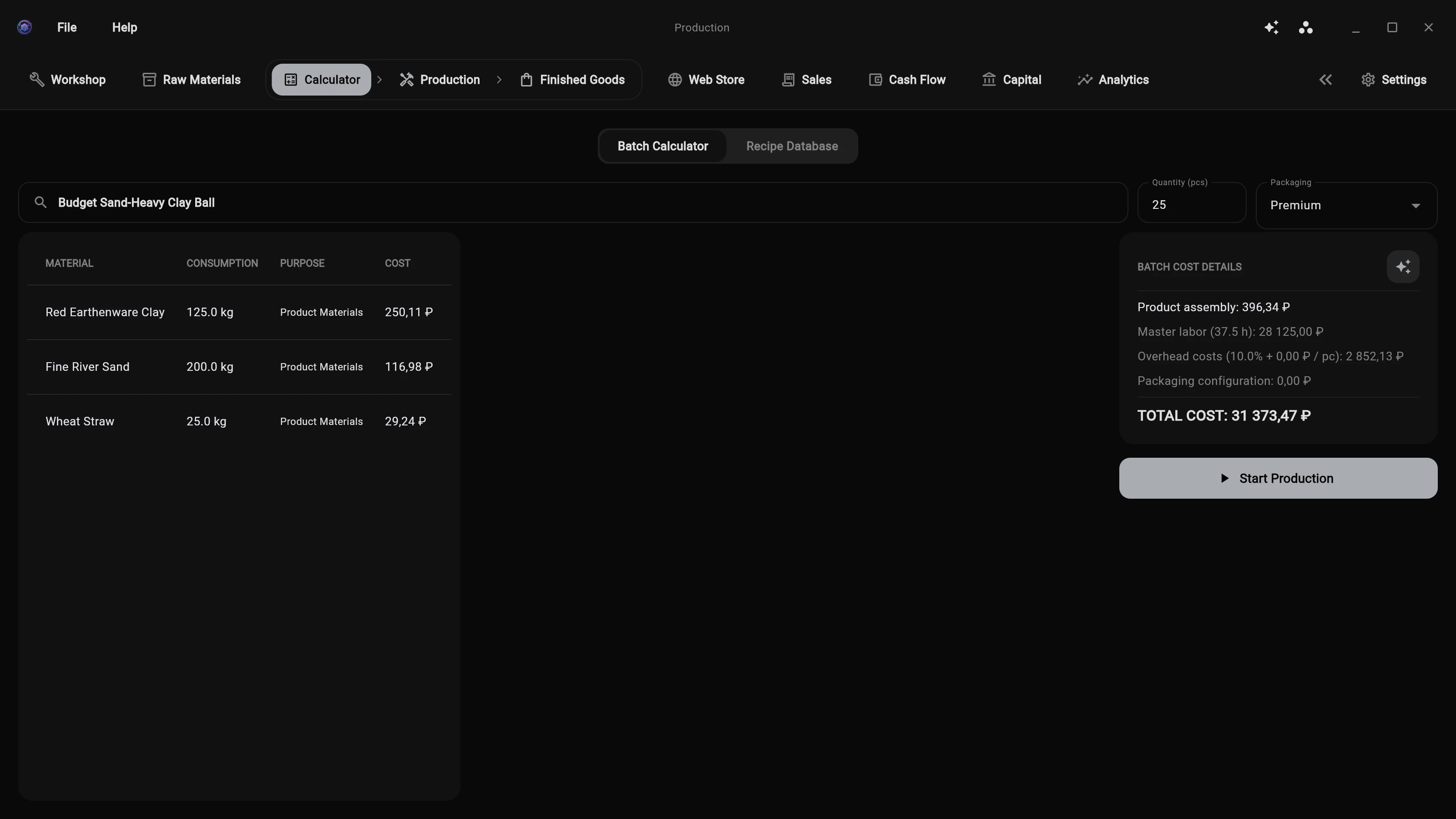
Store net pattern footage and cutting allowances inside each product recipe once. Whenever you quote or launch a batch, OmniCraft ERP pulls current Moving Average Cost (MAC) from your hide inventory, rolls in labor hours and shop overhead, and reserves the exact leather stock on click.
OmniCraft ERP for Makers
Recipes with MUC yield allowances, MAC inventory for hides and reusable offcuts, and exact labor costing. Free up to 20 sales.
Leather Cost Calculator
Enter net footage, waste factor, edge paint, hardware, and shop labor rate to get your minimum profitable selling price in 60 seconds.
Related Manufacturing & Economics Guides
- The Leather Scrap Trap: True Cutting Yield and Usable Hide Area — croupon, shoulder, and belly topography, MUC matrix, 10 cutting rules, and effective cost per square unit.
- What to Do with Leather Scraps: 5 Monetization Models & Remnant Inventory — 3-fraction grading, micro-goods matrix, scrap bundle sales, and the 6-Month Rule.
- Online Leather Goods Cost Calculator — interactive job costing factoring in hide footage, cutting scrap, edge finish, and labor hours.
- Pricing, Markup, and Margin: How to Never Sell at a Loss — flagship guide to craft retail math, profit margins, and breakeven volume.
- Cost Calculation Software for Workshops — architectural comparison of spreadsheets, corporate ERPs, and specialized craft tooling.